The Official Mouth
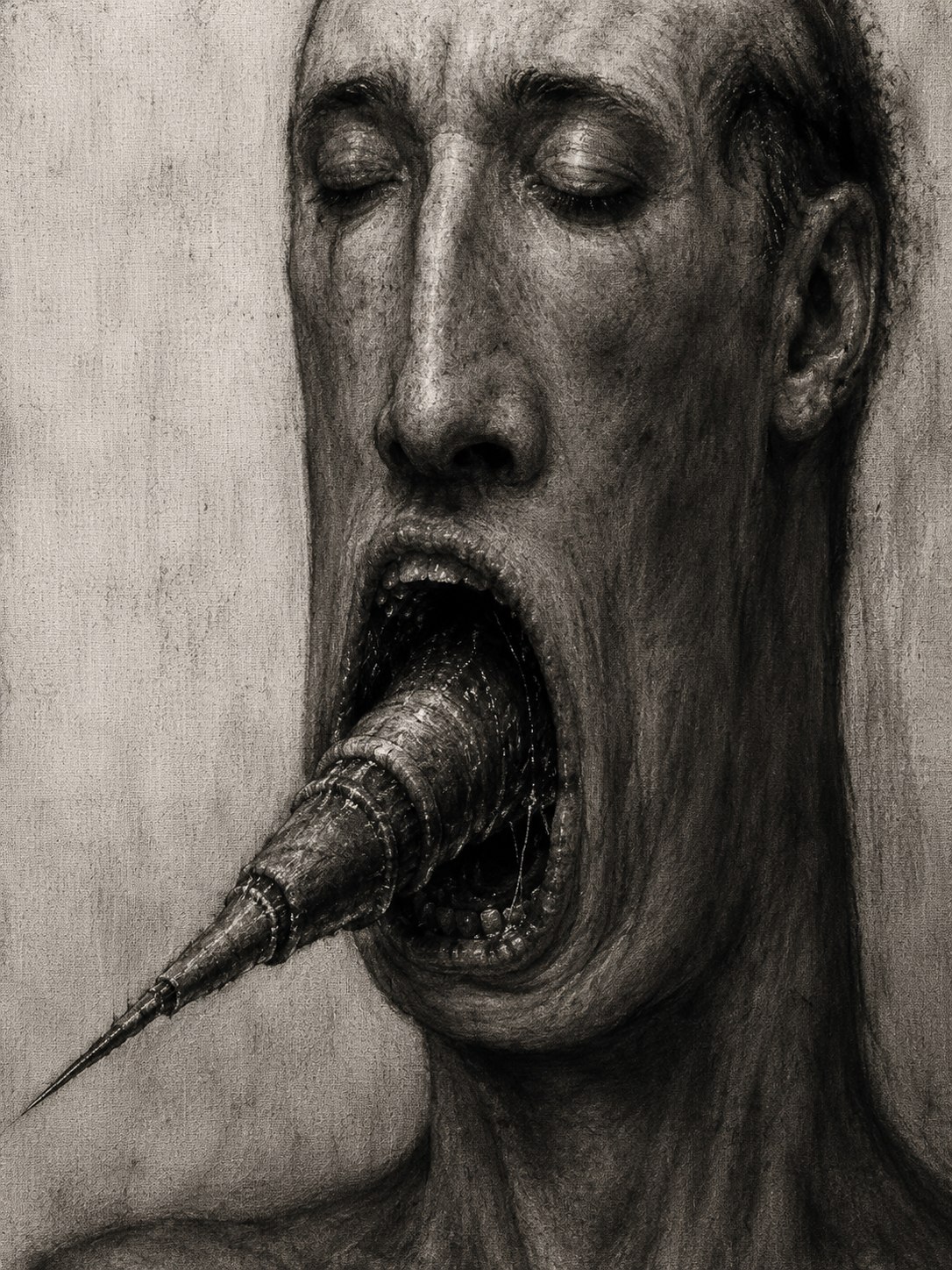
THIS IS A WORK OF FICTION
The lightning came down over Dhakuria at six-thirty in the evening, just when the city was most full of itself.
Buses coughed at the crossing. Autos whined like trapped insects. A man selling umbrellas under a torn blue sheet shouted that his umbrellas were Japanese, though they had been born, lived, and would shortly die in Burrabazar. Fish water ran silver along the pavement. The smell of hilsa, diesel, frying telebhaja, wet dust, incense, drains, and human patience mixed into the grand municipal perfume of June.
Nirmal Pal stood outside Buro-da’s tea stall with one trouser leg rolled up, because the lane had become a canal and because dignity, like footwear, was something Calcutta asked you to carry in your hand during rain.
“Don’t go now,” Buro-da said, pouring tea from a height. “Storm is doing rehearsal for apocalypse.”
“I have a student,” Nirmal said.
“You have two students and both are stupid. Stupidity can wait.”
Nirmal smiled because Buro-da liked his own cruelty salted properly. Across the road, a new coaching centre had put up a flex banner promising “GLOBAL CAREER TRANSFORMATION” beside an old wall where political posters peeled in exhausted layers. A boy stood under the banner, selling mosquito coils.
This was modern Bengali life now, Nirmal thought: everyone selling escape to everyone else, none of them moving.
He was forty-six, thin, careful, a tutor of mathematics and English for children whose parents still believed marks were a ladder instead of a painted backdrop. Once, long ago, he had worked in a private school near Jodhpur Park. Then the school had discovered “resource optimization,” that polished phrase under which men were dropped through trapdoors.
He still wore pressed shirts. He still carried a fountain pen. These things were not success, but they were evidence for the defense.
The first bolt split the sky above the railway line. The second struck somewhere behind the old Kalibari lane, where a rusted iron gate stood around nothing very holy anymore: one broken shrine, two peepal roots, and a municipal noticeboard warning against dumping garbage below a mountain of garbage.
The third bolt found Nirmal.
There was no cinematic lifting of the body, no blue skeleton shining through skin. Only a white crack in the world, a taste of copper, and a pain inside his mouth so sudden and intimate that he thought his tongue had been nailed to the roof of his skull.
He woke in the mud beside the gutter while rain slapped his face.
Buro-da was bending over him. “Oof, Pal-babu. Still alive?”
Nirmal tried to say, “My mouth.”
What came out was, “Mango chair railway boiled clock.”
Buro-da stared. Then, being Bengali, he drew the only reasonable conclusion.
“Concussion.”
By morning, Nirmal had a proboscis.
It was not the elegant needle of a mosquito, though later people would draw it so on pamphlets. It was thicker, jointed, black-brown, wetly polished, and ringed with small folds like the old leather bellows used by roadside cobblers. It emerged from his open mouth, pushing his tongue down and back, so that he could not close his lips or form any word that belonged to human society.
He discovered it in the cracked bathroom mirror.
For one full minute he did nothing. The ceiling fan clicked in the next room. A tram bell rang far away, delicate as a memory. Somewhere a pressure cooker whistled. Calcutta continued, which was rude of it.
Then he made a sound.
“Pomegranate funeral eleven spoon.”
His elder sister Mitali, who had come to collect the rent money he did not have, opened the bathroom door and saw him.
She did not faint. Mitali had survived marriage to a sweet-tongued alcoholic, two eviction threats, one gallbladder operation, and the coaching fees of a son who wanted to study hotel management without ever boiling water. She gripped the doorframe and said, “Nirmal, what nonsense have you done now?”
He pointed at his mouth.
“I can see your mouth.”
He shook his head violently. The thing moved, tasting air.
Mitali stepped back.
It was thirsty.
That was the next discovery. Not hunger. Hunger belonged to the stomach and could be bullied with muri, tea, or sleep. This thirst belonged to the whole body. It rang in his bones. It knew every pulse in the building.
From downstairs came the thin cry of Mrs. Ghosh’s grandson, refusing milk.
The proboscis lifted.
Nirmal clamped both hands over it and fell to his knees.
“Banana court father brick,” he pleaded.
Mitali’s face changed. For a second he saw not fear but calculation, then shame at the calculation.
“I’ll bring goat liver,” she whispered. “From the market. Don’t open the door.”
By noon the para knew.
It began, as all public disasters begin, with someone pretending to be discreet. Buro-da came with tea and left without the glass. The landlord’s nephew came to ask about a leaking pipe and stayed outside the door breathing loudly. Mrs. Ghosh, who had not climbed stairs since 2019 because of her knees, climbed two flights in order to say she was not curious.
Nirmal sat on his bed with the curtains drawn. The goat liver lay in a steel bowl. He had not eaten it. He had drunk from it.
That was worse.
Mitali sat beside him, her sari pallu pressed to her nose. “We should call a doctor.”
He wrote on an old electricity bill: NOT DOCTOR. THEY WILL TAKE ME.
“Who will take you?”
He underlined THEY.
Mitali looked irritated because terror was one thing, but vagueness another. “Government? Police? Circus?”
He wrote: EVERYBODY.
A little after three, Haru from the next lane pushed into the room. Haru was twenty-five, unemployed in a way that had become almost hereditary, with hair gelled into optimism and slippers that slapped authority into the floor.
“Let me see, Pal-kaku,” he said. “People are saying you became mosquito.”
Nirmal turned his face to the wall.
“Arrey, don’t be shy. We are all family here.”
The proboscis heard the pulse in Haru’s wrist.
It moved faster than Nirmal could think. One moment Haru was laughing; the next he was shrieking, arm stretched out, the black tube fixed into the soft part below his thumb.
Nirmal tried to pull away. The thirst pulled harder.
Blood came up through him.
Not into his stomach. Into his memories.
He tasted Haru’s cheap cigarettes, his mother’s fish curry, his fear of being useless, his secret habit of standing outside a gym he could not afford, watching other men manufacture their bodies into answers.
Then the proboscis released.
Haru fell back, pale and trembling.
Mitali slapped Nirmal across the cheek. “Dada!”
The word struck harder than her hand. She had not called him elder brother like that since childhood.
Haru stared at his wrist. The puncture was tiny. Already the skin around it had closed, clean as if kissed by ice.
“My chest,” Haru said.
“What?” Mitali snapped.
“My tightness is gone.”
Haru had suffered from a wheeze since the last monsoon, a family complaint treated with steam, scolding, and one inhaler bought after much drama. He breathed in, deep and theatrical. His eyes filled.
“He took it,” Haru whispered. “He took the bad blood.”
Nirmal shook his head.
“Window alphabet fish,” he said.
Haru folded his hands.
That evening the first flower garland appeared on the doorknob.
By nightfall, someone had named him Shunri Baba, because Bengalis cannot encounter the supernatural without immediately giving it a nickname suitable for tram conductors and neighborhood jokes. By the next morning the name had improved, or worsened, into Rakta-Mukhi Baba: the Blood-Mouthed Father.
Nirmal wrote signs and stuck them to the door.
I AM SICK.
DO NOT COME.
I CANNOT BLESS ANYONE.
The para read them with reverence.
“He is humble,” Mrs. Ghosh said.
“He rejects fame,” said the landlord’s nephew.
“Proper saint,” said Buro-da, though his eyes would not meet Nirmal’s.
On the third day Councillor Haradhan Dey arrived.
Haradhan wore a white kurta, white pajama, white sandals, and the expression of a man who had never personally created a problem but had heroically inaugurated many solutions. He stood outside Nirmal’s room with folded hands while two young men behind him carried marigolds, a brass plate, and a donation box.
“Nirmal-babu,” he said, “the people have faith.”
Nirmal wrote: FAITH IN WHAT?
Haradhan read it upside down, nodded solemnly, and replied, “Exactly.”
He entered without permission. The room was small enough that his importance had to crouch. He looked at the damp wall, the iron cot, the books stacked by subject and defeat, the unpaid bills held under a paperweight shaped like Victoria Memorial.
“You are educated,” Haradhan said softly. “So you understand society. People are suffering. Hospitals are crowded. Jobs are gone. Sons are sitting at home. Daughters are marrying late. Parents are selling gold for coaching classes. If they find relief here, who are we to insult them?”
Nirmal’s proboscis twitched at the pulse in Haradhan’s throat.
He wrote: I HURT HARU.
“Haru is calling it cure.”
HE IS FOOLISH.
Haradhan smiled. “That has never stopped a movement.”
Two evenings later, the queue reached the stairs.
They came with anemia, joint pain, exam fear, court cases, infertility, nightmares, business losses, foreign visa delays, and that general Indian condition which is not exactly illness but the feeling of being trapped inside a machine assembled by enemies and cousins.
Nirmal refused until an old rickshaw-puller from Selimpur cried quietly outside the door, saying he had not slept in twelve nights because of pain in his legs.
Mitali whispered, “Just a little.”
He wrote: NO.
She showed him the landlord’s notice.
The proboscis moved.
Only a little, he promised himself.
The old man sighed when it entered his wrist. His blood tasted of iron, sweat, rainwater, and a lifetime of being underpaid by people who called him dada while bargaining away his dinner. Nirmal drank three mouthfuls and stopped.
The man slept on the landing for two hours. When he woke, he touched Nirmal’s feet.
After that, refusal became cruelty.
Calcutta is a city where anything can become official if it first becomes a queue. Once a line forms, with plastic chairs, a register, one man shouting names, and one woman guarding slippers, morality gives up and joins the management committee.
By the following Sunday, Haradhan Dey had arranged a “Voluntary Rakta-Seva Camp” in the shuttered library beside the Kalibari lane. The old shrine had been washed. The garbage had been moved ten feet away, which in municipal terms counted as resurrection. A banner hung between two bamboo poles:
COMMUNITY RELIEF THROUGH TRADITIONAL BLESSING
ALL DONATIONS VOLUNTARY
NO POLITICAL COLOUR
Below that, in smaller letters, was Haradhan’s name in red.
Nirmal was brought there in a taxi with curtains pinned over the windows. He wore a clean kurta. Mitali had oiled his hair. The proboscis lay against his chest like a sleeping animal.
“You don’t have to do many,” she said.
He looked at her.
She looked away.
That was when he noticed the bandage on her wrist.
He seized her hand.
“Cloud bucket sister nail,” he said.
“It was nothing.”
He shook his head. His eyes stung.
She pulled free. “You were dying. Your skin was turning grey. What should I have done? Watched? I gave only a little.”
He wrote with a shaking hand: WHEN?
“The first night.”
The room seemed to tilt.
Before Haru. Before the garlands. Before the name.
Mitali had been first.
Outside, people chanted. Not loudly. Respectably. Respectability was important. Blood could be taken, but not manners.
“Baba, Baba, Rakta-Mukhi Baba.”
Nirmal wanted to run. Instead Haradhan’s men guided him to a wooden chair on a low platform. A brass plate of hibiscus sat at his feet. A register lay open. Names, ages, complaints, offerings.
A girl of eight came first, pushed forward by her mother.
“Only weakness,” the mother said. “She doesn’t eat. Always tired.”
Nirmal recoiled so violently the chair scraped back.
“No child,” Haradhan said at once, smiling for the crowd. “Baba has indicated no minors. See? Ethical protocol.”
Applause followed. Calcutta loved ethics most when they were announced after danger.
A clerk from a sweet shop came next. Then a woman with migraines. Then a retired tram employee whose son had gone to Pune and phoned only on festival days. Each time Nirmal drank a little and received not only blood but fragments: fear, resentment, boiled rice, damp pillows, bank forms, old songs, the smell of a dead wife’s hair oil.
The thirst eased. Something else grew.
Understanding.
Not human understanding. A low grammar of pulses. The city spoke under its traffic, under its slogans, under its conch shells and train horns. It was full of mouths waiting to open.
During the break, he saw the clue he had missed.
On the back wall of the cleaned shrine, half-hidden by fresh lime wash, someone had scratched words into the plaster long ago.
RAKTA NEY, ROG JAYE.
Blood taken, sickness goes.
Below it were dates.
And below those, almost erased:
OFFICIAL CAMP CLOSED BY ORDER.
Nirmal touched the wall.
A smell rose from the plaster: storm water, iron, wet mosquito net, old fear.
Behind him Buro-da said, “Don’t look there.”
Nirmal turned.
The tea seller stood with a garland in one hand and his mouth pinched small.
“You knew?”
Buro-da understood none of the words, but he understood the accusation. “My father told stories. In those days people said one man near Dhakuria Lake could pull fever from blood. Then too much happened. People got weak. Some died. Police came. After some years everyone forgot.”
Nirmal pointed to the banner outside.
Buro-da gave a miserable laugh. “We forget everything except the useful parts.”
A shout came from the hall.
Mitali had collapsed.
Nirmal found her sitting on the floor near the donation box, one hand pressed to her mouth. Blood slipped between her fingers.
He knelt.
“Open,” he tried to say.
“Don’t make drama,” she whispered.
Her tongue was swollen. Under it, just visible, was a dark thorn, no longer than a grain of rice.
Nirmal crawled backward.
Every person he had touched was standing very still.
Haru. The rickshaw-puller. The sweet-shop clerk. The woman with migraines. All of them with hands near their mouths, as if holding in a cough.
The room filled with a tiny sound.
Not chanting.
Clicking.
Haradhan Dey stepped onto the platform, sweating but composed. “No panic. Baba’s blessing is working deeply. Some reactions are natural.”
Nirmal looked at the register. Names filled three pages. Beside each name, Haradhan’s assistant had made a neat red tick.
Not patients.
Seeds.
The proboscis had not taken sickness. It had planted hunger around absence. It had made little blocked mouths inside ordinary mouths, and what people called cure was only the first silence before the new speech.
Mitali gripped his arm. Her eyes were wet with terror and apology.
“I thought,” she tried to say.
What came out was, “Copper window mango grief.”
The crowd gasped.
Mrs. Ghosh folded her hands. “Ma has received language.”
That did it.
Something broke in Nirmal, not madness but the last thread tying shame to obedience. He stood, took the fishmonger’s boti from the offering table, and placed the proboscis across its curved blade.
Haradhan shouted, “Stop him!”
Buro-da moved first, but not toward Nirmal. He threw hot tea into the face of the nearest party volunteer. For one priceless second, Calcutta remembered it had once been good at interruption.
Nirmal pressed down.
Pain opened white inside his skull. The proboscis fought, twisting, tasting the air for blood, for pulse, for permission. He leaned his full weight onto the blade. He thought of school registers, unpaid rent, his sister’s bandaged wrist, Haru folding his foolish hands, the little girl in the queue.
The thing came off with a sound like wet cloth tearing.
He fell.
The hall went silent.
The severed proboscis thrashed on the floor, black and muscular. No one moved. Then it dragged itself, blind but purposeful, across the tiles toward the open register.
Its tip dipped into the red ink pad.
Slowly, beautifully, it marked one more tick beside Nirmal Pal’s name.
Outside, thunder rolled over Dhakuria.
Rain began again, heavy and official.
When Mitali screamed, her mouth opened wide. From beneath her tongue, the little thorn unfolded, joint by joint, and pointed toward the crowd.
Haradhan Dey, who recovered faster than decent men do, looked from her to the register, then to the people waiting in the rain.
“Please maintain line,” he said, voice trembling with opportunity. “The camp will resume shortly.”